Physical Address
304 North Cardinal St.
Dorchester Center, MA 02124
Physical Address
304 North Cardinal St.
Dorchester Center, MA 02124

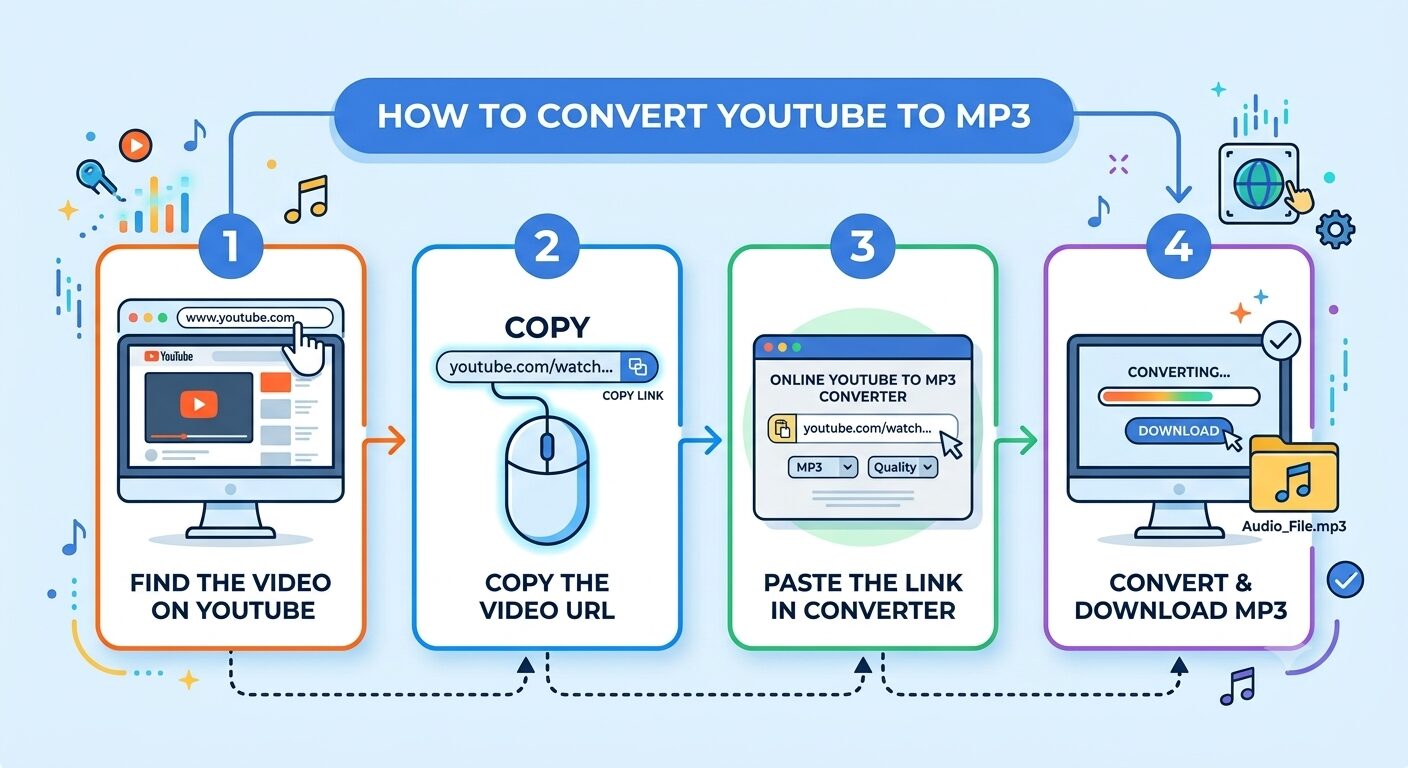
Converting a YouTube video to MP3 is useful when you need an audio-only file for a project, a voice memo backup, a private lesson, a podcast draft, or saving educational content you own. However, not every video should be downloaded or converted. Only convert YouTube content you own, have permission to use, or that is clearly licensed for download and offline viewing.
A YouTube to MP3 workflow can be simple, but the safest approach depends on what you are converting. If it is your own uploaded video, download the video files from your YouTube account first, then convert video to MP3 with trusted software. If it is a permitted third-party video, use a reliable YouTube to MP3 converter carefully to ensure a smooth experience. Avoid suspicious pop-ups, browser extensions, or sites lacking an ad-free environment that ask for unnecessary permissions. ⚡
Before you convert YouTube videos to MP3, prepare the basics for a hassle-free process:
A YouTube link for the target video.
Permission to download content or reuse the audio.
A stable internet connection to ensure fast conversions.
Enough storage space for your MP3 file or MP4 files.
A trusted method, such as desktop software or a reputable, completely free to use online ytmp3 tool.
Headphones 🎧 to check the final sound quality.
Conversion Workflows at a Glance
| Goal | Recommended Process |
| Your Own Content | Download from YouTube ➔ Use desktop video to MP3 converter ➔ Save as MP3 format. |
| External Videos | Copy URL ➔ Paste into free YouTube to MP3 downloader ➔ Select MP3 ➔ Download files instantly. |
This is the best option when the video is yours. It gives you more control over audio quality, avoids questionable youtube downloader sites, and usually produces cleaner mp3 audio files.
Sign in to the YouTube account where the video is published. Go to your content library, find the video, and use the available option to download YouTube videos. Save the mp4 file somewhere easy to find.
Use clear folder names like:
Podcast Episodes
Lecture Audio
Client Video Conversions
Use a trusted media conversion app to handle the mp4 to mp3 conversion. Open the app, choose the export option, and add your downloaded video.
Look for settings such as:
Output format: MP3
Audio quality: Medium or high (e.g., 320kbps for premium quality)
File name: Keep it short and descriptive.
When you reach the export settings, select MP3. This audio file format is universal, working on nearly every device, including mobile phones, laptops, and car stereos.
A good file name might look like:
morning-yoga-instructions.mp3
product-demo-voiceover.mp3
Avoid vague names. Clear names make your MP3s easier to search and archive.
Click the convert button. The time it takes to quickly convert your file depends on the length of the video. Once done, open the track and listen to the beginning, middle, and end. This check helps you catch missing audio, long silences, or if a lossy compression distorted the track. ✅
An online YouTube converter is highly convenient because you do not need to install software. This method is ideal to extract audio from a video quickly using any modern browser.
Open the video. Copy the url from the address bar or use the share button. Confirm you are allowed to download music from YouTube or extract the audio (e.g., Royalty-free content, public domain).
Open your chosen free tool and paste the link into the input box. A trustworthy free YouTube to MP3 site will let you extract audio without forcing you to install browser extensions.
Decide whether you need videos to mp3 or mp4. For standard audio, choose MP3. Many tools offer varying resolutions like 360p, 720p, 1080p, or even 4k for video downloads, alongside quality audio bitrates like 320kbps.
Hit the convert button. Once processed, download the MP3 to your device. After downloading, check the file carefully:
Does it play perfectly from start to finish?
Is it truly an MP3 file?
Did the site trigger any unwanted pop-ups? (Seek out ad-free sites for a safer experience). 🎵
You can convert YouTube to MP3 directly on your phone, though mobile workflows can sometimes be less predictable.
If you are converting your own video, a safer workflow is:
Download or transfer the video files to your phone.
Open a trusted mobile MP3 converter app.
Export the video and audio track as an MP3.
Save the MP3 to your files or cloud storage.
If you use an online youtube video converter on mobile, avoid tapping deceptive ads.
Balancing quality and file size depends entirely on what you plan to do with the file.
Spoken Word: For lectures, tutorials, or meetings, a moderate quality setting is usually fine. It keeps the file size small while voices remain understandable.
Music & Sound Design: Choose higher-quality settings (like 320kbps) when available. Keep in mind that converting a low-quality original will not magically improve the sound quality. The final output is only as good as the source.
The MP3 has no sound
Make sure the original video contains audio. Try converting the file again with a different video to MP3 converter or output setting.
The file is too large
Choose a lower audio quality setting or trim unnecessary sections before exporting. Long webinars can create massive audio files.
The audio sounds distorted
Try a different converter or reduce any volume boost settings. Distortion often happens when the source audio is already loud.
The converter keeps opening pop-ups
Close the page. A reliable youtube downloader should provide a safe, hassle-free process without forcing notifications or unwanted apps.
Can I convert multiple videos at once?
Yes, some premium desktop applications and specific online tools allow batch conversion, letting you turn multiple videos into MP3 format simultaneously.
Taking a minute to properly organize your library saves time later, especially if you regularly convert favorite videos from YouTube or platforms like TikTok into MP3s.
Use a consistent naming system, such as:
creator-topic-date.mp3
project-episode-number.mp3
Final Checklist
Before you use or share the MP3, confirm the following:
[ ] You have the right to convert and use the educational content or media.
[ ] The file is saved precisely as an MP3 format.
[ ] The audio plays clearly from beginning to end.
[ ] You removed any unwanted downloads or duplicate files.
Key Takeaway: The easiest way to convert YouTube video to MP3 is to copy the link, use a trusted youtube to mp3 converter, select MP3, and download the audio. The safer method, especially for your own content, is to download the video first and convert it offline. Whichever route you take, use reputable tools, respect content rights, and always verify your final audio file.

I am Muhammad Ali the founder and lead voice behind Techgory, a platform born out of a deep fascination with everyday technology and digital tools. Instead of relying on dense, confusing jargon, I focus on heavy research, hands-on testing, and breaking down complex tech into simple, actionable steps that anyone can understand.
Comments are closed.



[…] Als0 Read How to convert yt to mp3 […]